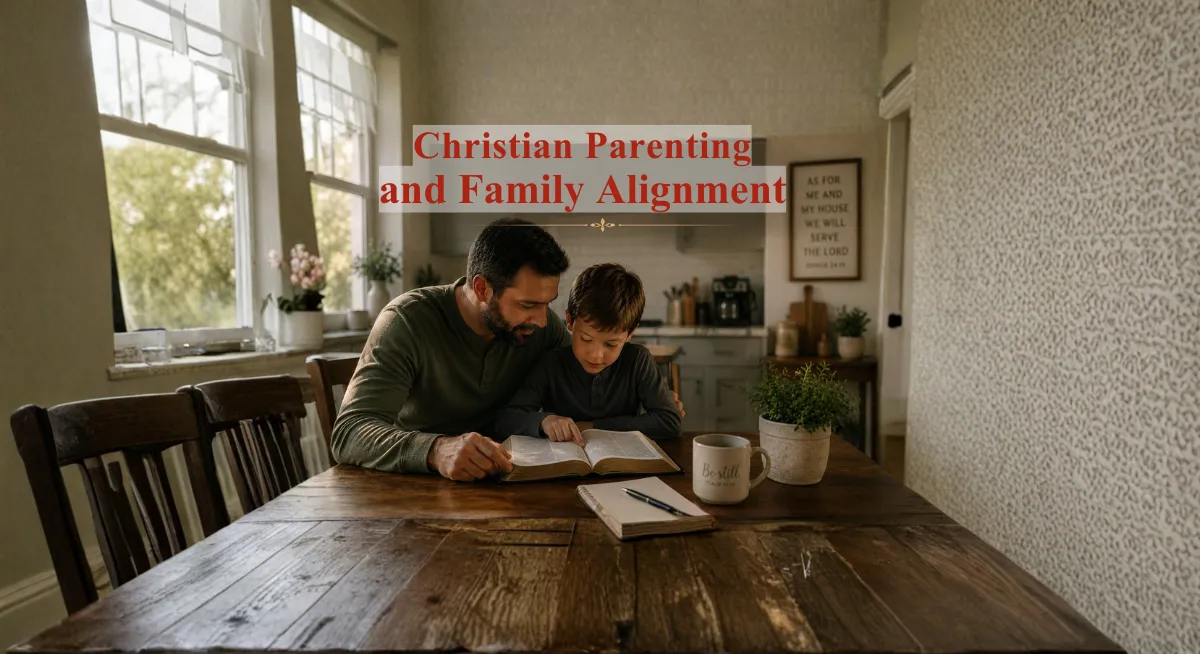
Christian Parenting and Family Alignment
Why the Parent You Are Matters More Than the Techniques You Use
Quick Answer: Christian parenting is primarily about the ongoing Alignment of the parents — walk with God, marriage, inner life, and home rhythms — because kids absorb who you are while you think you're teaching them. Techniques matter and they land with weight when the parent's Alignment is the environment your children are growing inside.
A good Christian parent walks into a bookstore, or opens a podcast feed, and finds an entire ecosystem of advice. Discipline strategies. Screen time rules. Conversation frameworks. Devotional routines. Age-appropriate theology curricula. Scripts for hard moments. Every piece of that advice can be useful, and every piece together can obscure the one truth that actually shapes Christian families. Kids absorb who you are while you think you're teaching them. The techniques matter. The parent matters more.
If you've searched "Christian parenting," "biblical parenting advice," or "faith-based family Alignment," this post walks through the reframe most Christian parenting resources never name, and the practical Alignment work that changes what's actually forming in your home.
Get the Gist Quick
The short version, because if you're reading an article on Christian parenting, one of your kids probably needs something from you in the next twenty minutes.
Christian parenting works best when the parent is Aligned. Aligned means you're walking with God yourself, your marriage is being tended, your own mental, emotional, and physical life is getting the care it needs to keep you present, and the rhythms of your home reflect your actual values, not your stated ones.
Kids don't grow up absorbing what you say. They grow up absorbing what you live. The instruction matters and it lands inside the atmosphere of your actual character. When the atmosphere is Aligned, the instruction takes root. When the atmosphere contradicts the instruction, kids learn to privilege what they saw over what they heard, almost every time.
That doesn't mean you need to be a perfect parent. The work of Christian parenting starts with your own ongoing Alignment with God, spouse, self, and home. Barna research shows that 95% of children's ministry leaders agree the home should be the primary environment for discipleship, while only 55% of churched adults agree1. That gap is the work this post addresses. The techniques come next, and they land beautifully when the Alignment is holding.
Keep reading for the practical picture.
And now… the rest of the story.
What Most Christian Parenting Advice Misses
Most good Christian parenting resources focus on the child. What to teach. How to discipline. Which devotional to read. How to handle the conversation about gender, sexuality, phones, friendships, Faith doubts. The child is the subject. The parent is the technician applying the techniques.
The Shema has a different center of gravity. "These commandments that I give you today are to be on your hearts. Impress them on your children" (Deuteronomy 6:6-7, NIV). Notice the order. Before anything is impressed on the children, the commandments are on the hearts of the parents. Formation flows from who the parents are into who the children are becoming. The parents aren't the technicians. They're the environment.
As we walked through in God's Blueprint for the Family, Scripture treats the family as a designed institution with parents as the primary disciplers. That designation changes the whole frame. Christian parenting is the formation of parents whose walk with God becomes the context their children grow up inside.
What's the Central Thesis?
Christian parenting is primarily about who your kids are absorbing while you think you're teaching them.
Every one of us was parented by people who taught us things with their words and more powerful things with their lives. The way Dad handled disappointment. The way Mom talked about her own Faith when she was tired. How they fought. How they repaired. What they laughed at. What they protected. What they apologized for. What they were never willing to examine. All of that formed us long before any of the intentional lessons did.
Our kids are in the same process right now. The atmosphere of your home is forming them at a level that's deeper than any curriculum, which means the most important Christian parenting work is the ongoing work of your own Alignment.
What Four Ways Does Parental Alignment Shape Kids?
Alignment shows up in specific dimensions, each of which your kids are absorbing whether you've thought about it or not.
Alignment 1: Your Walk With God
Your kids are watching how you relate to the Lord when nobody's performing. They see how you react to hard news, how you Pray about things that matter to you, how you read Scripture or don't, whether your Faith produces peace or produces anxiety, whether you apologize to God or just to your kids, whether Worship is a duty or a delight. They form their early theology on it, long before any Sunday School curriculum gets involved.
When your walk is genuine, imperfect, honest, and ongoing, it gives your kids a vocabulary for their own walk that no lesson plan can produce on its own.
Alignment 2: Your Marriage
In Faith-Based Marriage & Family Alignment, we named that the marriage is the keel of the family. What the marriage is, the family becomes. Your kids are watching your marriage more closely than they'll ever articulate. They absorb how you talk to your spouse when you're tired, how disagreements get handled, whether repair happens, whether tenderness is public, whether the two of you are actually Aligned or operating parallel.
When the marriage is being tended, the kids grow up inside a safety they didn't know they had. When the marriage is drifting, the kids feel it even when they can't name it, and they grow up learning patterns they'll likely reproduce in their own marriages someday.
Alignment 3: Your Own Inner Life
The version of you your kids meet every day is shaped by how well you're tending your own inner world. Your sleep. Your stress. Your unprocessed grief. Your emotional regulation. Your friendships. Your sense of Calling. All of this shows up in the parent you actually are.
A Christian parent who neglects their own interior shows up with less patience, less presence, and less capacity than the work of parenting requires. The self-care that some Christians suspect is self-indulgent is often the condition of the vessel through which the parenting itself gets delivered. When you tend your own soul, your kids get more of you. When you neglect it, they get a shell.
Alignment 4: The Rhythms of Your Home
Your home has rhythms whether you designed them or not. Meal patterns. Screen patterns. Conversation patterns. Sabbath patterns. The sound of the house in the morning. The tone of the evening. What gets celebrated. What gets stressed about. What goes unexamined. These rhythms teach your kids what matters more than any explicit instruction.
In Functional Families That Aren't Thriving, we walked through how a family can run smoothly while quietly going hollow. The fix is almost always in the rhythms. A family where Sabbath is real, shared meals are slow, Prayer is honest, and Scripture shows up in conversation forms kids differently than a family whose rhythms reflect efficiency, optimization, and achievement.
What Parenting Misalignments Are Worth Naming?
A few drift patterns show up often in Christian parenting, and naming them helps parents notice where an adjustment is available.
Outsourcing the formation. The youth group, the Christian school, the Christian media streaming service, the devotional app are all helpful supports. None are substitutes for parental discipleship. When the formation gets outsourced, the kids pick up the signal that the parents aren't the primary place where Faith gets learned.
Prioritizing achievement over character. Most Christian parents would say character matters more than performance. The calendar, the conversation topics, and the pride patterns in the home often tell a different story. The kids absorb which is actually getting prioritized.
Avoiding repair when parents are wrong. Parents who admit when they're wrong raise kids who know how to admit when they're wrong. Parents who can't apologize raise kids who learn that apology is optional, or worse, a sign of weakness. Repair is a skill kids learn by watching their parents practice it.
Running a performance of Faith rather than practicing one. Kids can tell the difference between performed Faith and practiced Faith by about age ten. The performed version shows up at Church, Bible study, and family devotions, and disappears the rest of the week. The practiced version shows up everywhere, quietly, without announcement.
These drifts don't make a parent a failure. They're signals that Alignment work is available, and that available work usually produces real change when parents pick it up.
What Practical Alignment Rhythms Fit Most Family Seasons?
Alignment becomes tangible through small, sustainable practices.
A daily Scripture rhythm for yourself. Ten minutes. Your own formation, not parenting material. Let your kids see you reading Scripture for yourself, not for them. The example teaches them that Scripture is for adults too, not something reserved for their curriculum.
A weekly marriage check-in. Fifteen minutes, protected. If the marriage is being tended, the parenting gets easier. If the marriage is drifting, everything else gets harder whether your kids can name it or not.
A family Sabbath that actually stops. One day a week where the productivity engine rests. Meals are slower. Screens are reduced. Presence is the point. A weekly Sabbath teaches kids that humans aren't machines, which is one of the most countercultural things you can teach them in this particular decade.
Repair on purpose. When you're wrong with your kids, apologize clearly and specifically. "I was sharp with you this morning. I was wrong, and I'm sorry." That one sentence teaches them Grace, confession, and repair in about ten seconds. Most curricula take weeks to teach what one sincere apology teaches in a moment.
Honest conversation that includes your doubts and growth. Your kids don't need a parent who has Faith figured out. They need a parent whose Faith is alive and honest. Talk about what you're learning. Name where you're struggling. Let them see Christian formation as an ongoing conversation they're invited into, not a performance they're expected to replicate.
Live Your Legacy Today
On any given Tuesday morning, honesty looks like this.
You need an ongoing practice of your own Alignment. Your walk with God. Your marriage. Your inner life. The rhythms of your home. These are the environment your kids are being formed inside, and when the environment is tended, the techniques you do employ land with weight the techniques alone could never carry.
Your kids will remember a thousand moments you don't remember, and most of them will be moments when you weren't thinking about parenting at all. The way you treated your spouse on a Tuesday night. The tone you used when you thought nobody was listening. The way you Prayed when the news was bad. What you laughed at together. What you apologized for. What you protected.
Aligned parents don't raise perfect kids. They raise kids who learned what a Christian adult actually looks like in the slow, daily practice of following Jesus, and that's the Legacy worth leaving.
Key Takeaways
Christian parenting works best when the parent is Aligned. The parent is the environment your kids grow up inside, deeper than any curriculum or technique.
The Shema's order is parent first, child second. Formation flows from who the parents are into who the children are becoming.
Four dimensions of parental Alignment shape kids: walk with God, marriage, inner life, and home rhythms.
Common drifts include outsourcing formation, prioritizing achievement over character, avoiding repair, and performing Faith rather than practicing it.
Practical Alignment rhythms: daily Scripture for yourself, weekly marriage check-in, family Sabbath that stops, repair on purpose, and honest conversation about your own growth.
Aligned parents don't raise perfect kids; they raise kids who learned what a Christian adult actually looks like in daily practice.
Going Deeper
In my upcoming book, Your Purpose & Principle Driven Life 2.0, we walk through the full P2-Driven Framework, Get Clear, Align, Get Fit, and Live Your Legacy Today, applied to Christian parenting specifically. The book addresses the formation of parents whose walk with God shapes the home their kids are growing inside, the rhythms that sustain that formation across seasons, and the honest acknowledgment that most parenting wins are invisible at the time they happen.
What Coaching From AI Bots Misses
An AI bot can generate you a complete Christian parenting plan for any age range in under ninety seconds. Discipline strategies, devotional rhythms, conversation starters, age-appropriate theology, screen time frameworks. A Christian parent can read the whole thing in half an hour. Most parents who read it will still face the same challenges the following week, because the challenge was never the lack of information.
Parenting shifts when the parent shifts. A coach sees the pattern you've been running since before the kids were born. A coach notices when your reaction to your child is actually about something unresolved in you. A coach stays in the work while you do the Alignment your kids have been quietly waiting for you to do. The coach doesn't coach your kids. The coach coaches the parent whose Alignment is the environment your kids are growing in.
A bot generates a plan. Christian parenting is less about the plan and more about the parent, and the parent's growth requires another person in the room who knows the territory.
→ If you're ready to do the Alignment work your parenting has been asking for, book a discovery call: https://p2driven.com/discovery-call
FAQ: Christian Parenting and Family Alignment
What's the most important thing in Christian parenting?
The ongoing Alignment of the parents. Scripture gives parents the primary role in discipling their children, and that role is fulfilled more through who the parents are than through any single technique. Your walk with God, your marriage, your inner life, and the rhythms of your home form your kids at a level deeper than any lesson plan.
Does this mean I have to have it all together before I can parent well?
No. Nobody has it all together. Alignment is a direction, not a destination. Your kids don't need perfection. They need an honest parent whose walk with God is real and ongoing, whose marriage is being tended, whose own soul is getting cared for, and whose home has rhythms that reflect stated values. Imperfect, honest, ongoing beats polished performance every time.
What if my spouse isn't on board with the Alignment work?
Your own Alignment still matters enormously. Kids benefit from even one parent who's doing the work, and your consistent example often becomes the catalyst for your spouse over time. Build rhythms into your own life. Pray for your spouse. Avoid turning Alignment into leverage in the marriage.
How do I handle it when I've already made mistakes as a parent?
Repair is one of the most powerful tools available to you. Acknowledge the mistake clearly to your child, apologize specifically, and keep going. Kids benefit more from a parent who models confession and growth than from a parent who insists on having gotten it right the first time.
Do my kids need to be in a Christian school or homeschooled for this to work?
The blueprint doesn't prescribe any particular schooling model. Faithful Christian families make thoughtful decisions across the full range of options. What matters most is that the parents remain the primary disciplers regardless of which school their kids attend.
How does the Shema (Deuteronomy 6) apply to modern Christian parenting?
The Shema names parents as the primary disciplers and daily life as the curriculum. Modern application means the conversation about God happens in cars, at meals, on walks, before bed, not only at Church. Parents who weave Faith into ordinary moments are doing what the Shema asks.
How much time per week does parental Alignment actually take?
Less than you'd expect, if it's consistent. Ten minutes of Scripture daily, fifteen minutes with your spouse weekly, a Sabbath that genuinely stops, and the willingness to repair when you're wrong. Maybe two hours a week of structured time. The rest is presence inside ordinary life.
