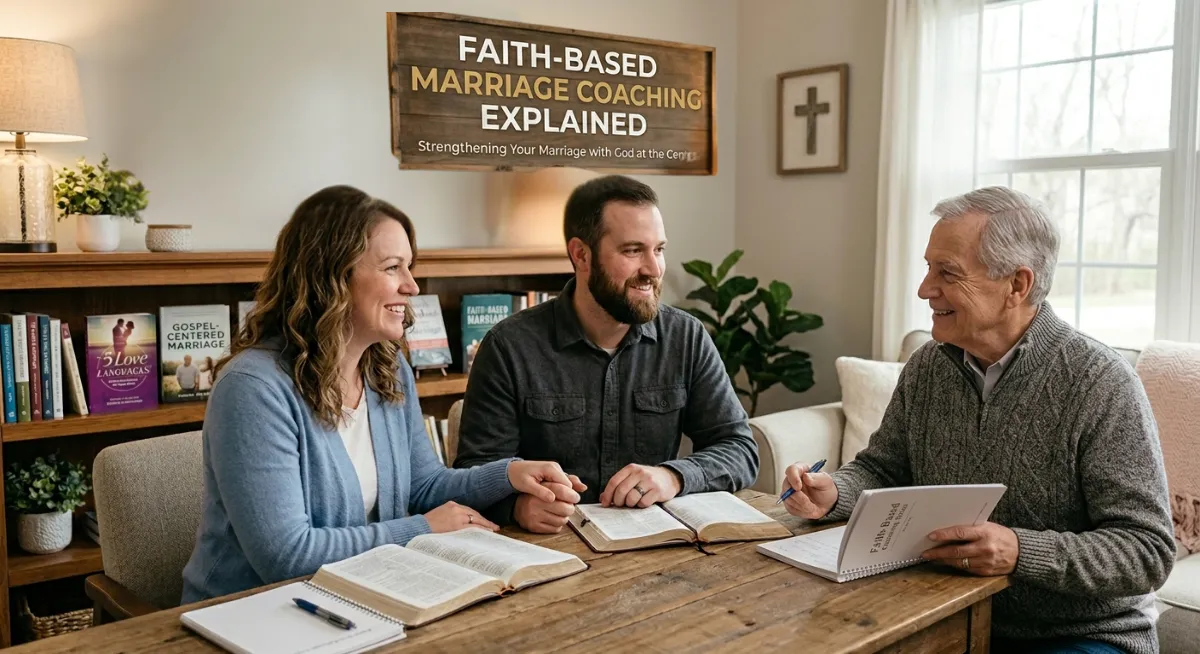
Faith-Based Marriage Coaching Explained
What It Is, What It Isn’t, and Why the Strongest Couples Invest in Alignment Over Advice
If you’ve searched “faith-based marriage coaching,” “Christian marriage coaching near me,” or “marriage coaching vs counseling,” you’re probably not looking for another list of tips. You’ve read the articles. You’ve tried the date nights. You might’ve even sat through a marriage retreat where someone told you to use “I” statements and schedule more quality time. Yet none of it stuck, not because it was wrong, but because it never got underneath the thing that’s actually off. Faith-based marriage coaching isn’t therapy with a Bible verse taped to it. It’s a different framework entirely, one built on Alignment with God’s design for marriage, not just better conflict resolution.
Get the Gist Quick
Here’s the short version, because I know you’re reading this between something that just ended and something that’s about to start.
Most people show up to marriage coaching thinking they have a communication problem. They don’t. They have a direction problem. Two people who love each other, who share the same Faith, who said the same vows, and somewhere along the way stopped walking toward the same thing. The conversations got shorter. The Prayer life went solo. The calendar filled up with everything except each other. Nobody planned it. That’s what makes it dangerous.
Faith-based marriage coaching starts with a question most approaches skip: What is your marriage oriented toward? Not “what’s broken?” or “who’s right?” but “where are you both pointed?” Because when two people are individually chasing God but never checking whether they’re chasing Him together, you don’t get rebellion. You get parallel lives. Faithful. Busy. Disconnected.
The fix isn’t more effort. It’s shared direction. That’s what coaching builds.
If that’s the version you needed, good. If you want the full picture, keep reading.
And now… the rest of the story.
Get Clear: What Faith-Based Marriage Coaching Actually Is
Let’s clear the fog, because the phrase “faith-based marriage coaching” carries a lot of baggage depending on where you’ve heard it.
It’s not counseling. Counseling focuses on diagnosing dysfunction, processing trauma, and treating clinical conditions. That work is valuable, and if you need it, go get it. Coaching occupies different territory. Coaching assumes you’re not broken. It assumes you’re capable, smart, and motivated, and that something in your operating system is producing results you didn’t intend.
It’s not a Bible study for couples. There’s no curriculum. Nobody’s grading your quiet time. Scripture matters deeply in this work, but it functions as a compass, not a checklist.
And it’s not pastoral counseling, either. Your pastor cares about your marriage, but most pastors aren’t trained to sit with you for twelve weeks while you rebuild the rhythms that hold a family together.
Faith-based marriage coaching is structured, ongoing partnership with someone who helps you and your spouse get honest about where you are, where you’re headed, and what’s keeping you from walking in the same direction. As we explored in Marriage as Spiritual Alignment, the strongest marriages aren’t built on compatibility. They’re built on shared direction toward God. Coaching is what helps you find that direction again when life has buried it under logistics, exhaustion, and good intentions that ran out of gas.
Align with God’s Heart: Why Direction Matters More Than Technique
Here’s the part most marriage advice misses entirely.
Technique without direction is just polished dysfunction. You can learn every active listening skill in the book and still never ask your spouse the question that actually matters. You can schedule weekly date nights and spend every one of them avoiding the conversation you both know you need to have.
In Marriage Drift and Realignment, we walked through how marriages don’t collapse in a single moment. They erode through a thousand small decisions nobody flags as dangerous. The Prayer you stopped sharing. The stress you stopped splitting. The vulnerability you replaced with efficiency. Drift doesn’t announce itself. It just accumulates until one day you’re sitting across from someone you love and realizing you’ve been building separate lives under the same roof.
Faith-based coaching addresses that drift at the root, not by adding more tools to a misaligned system, but by reorienting the system itself. It starts with the question Jesus built everything on: What is the greatest commandment? Love God. Love people. “All the Law and the Prophets hang on these two commandments” (Matthew 22:40, NIV). Your marriage is the primary proving ground for both.
When a couple Aligns around that – when the compass heading is God’s heart instead of each person’s preferences – the techniques start working because they finally have somewhere to point.
The Rhythms That Make Alignment Sustainable
Alignment isn’t a one-time decision. It’s a set of rhythms you protect.
A weekly check-in, maybe fifteen minutes or so with no screens or logistics. Just: “How are you really doing? How are we really doing?” This one rhythm catches drift before it calcifies. That’s not dramatic. It’s directional.
How about a shared Prayer rhythm? One that’s not performative, just honest. Something shifts when two people stop Praying past each other and start Praying together about the things they’re actually afraid of. Walls come down that no counseling technique can dismantle.
You need protected presence, perhaps one evening, one meal, one morning where the only agenda is being together. As we discussed in What Your Calendar Teaches Your Family, your calendar reveals your real priorities. If your spouse never shows up on it, they’ve learned where they rank.
What about an annual recalibration to get away and ask the hard questions. Where are we? Where are we headed? What’s working? What isn’t? This isn’t a vacation. It’s an Alignment meeting, likely the most important one you’ll attend all year.
These aren’t tips. They’re load-bearing structures, and Faith-based coaching helps you build them into a marriage that’s already moving fast.
Live Your Legacy Today: What Your Marriage Is Teaching Right Now
Your marriage is already modeling something. The question is whether it’s modeling what you want it to.
Your kids are watching how you handle conflict, whether you shut down or stay in the room. Your friends are watching whether your Faith produces intimacy or just coexistence. Your Church community is absorbing whether the Gospel makes marriages thrive or merely survive.
Legacy isn’t formed at the 50th anniversary party. It’s formed on a random Tuesday when you choose repair over retreat. When you say “I was wrong” before anyone asks you to. When you protect fifteen minutes of connection in a week that’s trying to squeeze it out.
Faith-based marriage coaching doesn’t just help you fix what’s off. It helps you build something worth passing down, a marriage that teaches your kids what covenant looks like, what Forgiveness costs, and what it means to Love someone on purpose over a lifetime.
That’s Legacy in the present tense, and it starts with two people choosing shared direction over separate momentum.
Going Deeper
In my upcoming book, Your Purpose & Principle Driven Life 2.0, I wrote an entire chapter on The Believer & Family – how to diagnose where your marriage drifted, how to rebuild Alignment before God, and how to create the rhythms that make intimacy sustainable over decades. If this post named something you’ve been feeling but couldn’t articulate, the book gives you the full framework to act on it.
What Coaching From AI Bots Misses
AI can define Faith-based marriage coaching in under three seconds. It can generate a comparison chart, list five warning signs, and recommend three communication exercises before you finish your coffee. What it can’t do is sit across from two people who love each other but have forgotten how to show it and ask the one question that unlocks everything.
Real coaching sees the pattern underneath the presenting problem. It holds space for the silence between the sentences. It knows that the argument about the budget isn’t really about the budget. AI gives you information. A coach gives you presence and that can help change marriages.
→ If you’re ready for that conversation, book a discovery call: P2Driven.com/discovery-call
FAQ: Faith-Based Marriage Coaching
What is faith-based marriage coaching?
Faith-based marriage coaching is a structured, ongoing partnership that helps couples Align their marriage around God’s design. It’s not therapy and it’s not pastoral counseling. It assumes you’re capable and motivated and that something in your operating system is producing results you didn’t intend. Coaching helps you identify the misalignment and build the rhythms that correct it.
How is faith-based marriage coaching different from marriage counseling?
Counseling typically addresses dysfunction, trauma, and clinical conditions. Coaching addresses direction. It’s for couples who aren’t in crisis but know something’s off, the couple who’s functional but disconnected, busy but not building together. Coaching goes underneath communication techniques to address what your marriage is oriented toward.
Do both spouses need to participate?
Ideally, yes. But coaching can begin with one person. When one spouse starts changing their posture, how they respond, how they Pray, how they show up, it shifts the dynamic. You can’t force Alignment, but you can model it. Often, when one person begins to genuinely change, the other takes notice.
What does a faith-based marriage coaching session look like?
Sessions are typically 60 minutes, one-on-one with the coach or with both spouses present. The coach helps you identify patterns, clarify direction, and build practical rhythms for Alignment. Scripture is woven into the process as a compass, not a curriculum. The goal is shared direction, not perfection.
Is faith-based marriage coaching only for Christian couples?
The framework is built on biblical principles and a Christ-centered view of marriage. It’s designed for couples who want their Faith to be the foundation of their relationship, not an add-on. If that resonates with where you are, this is for you.
